

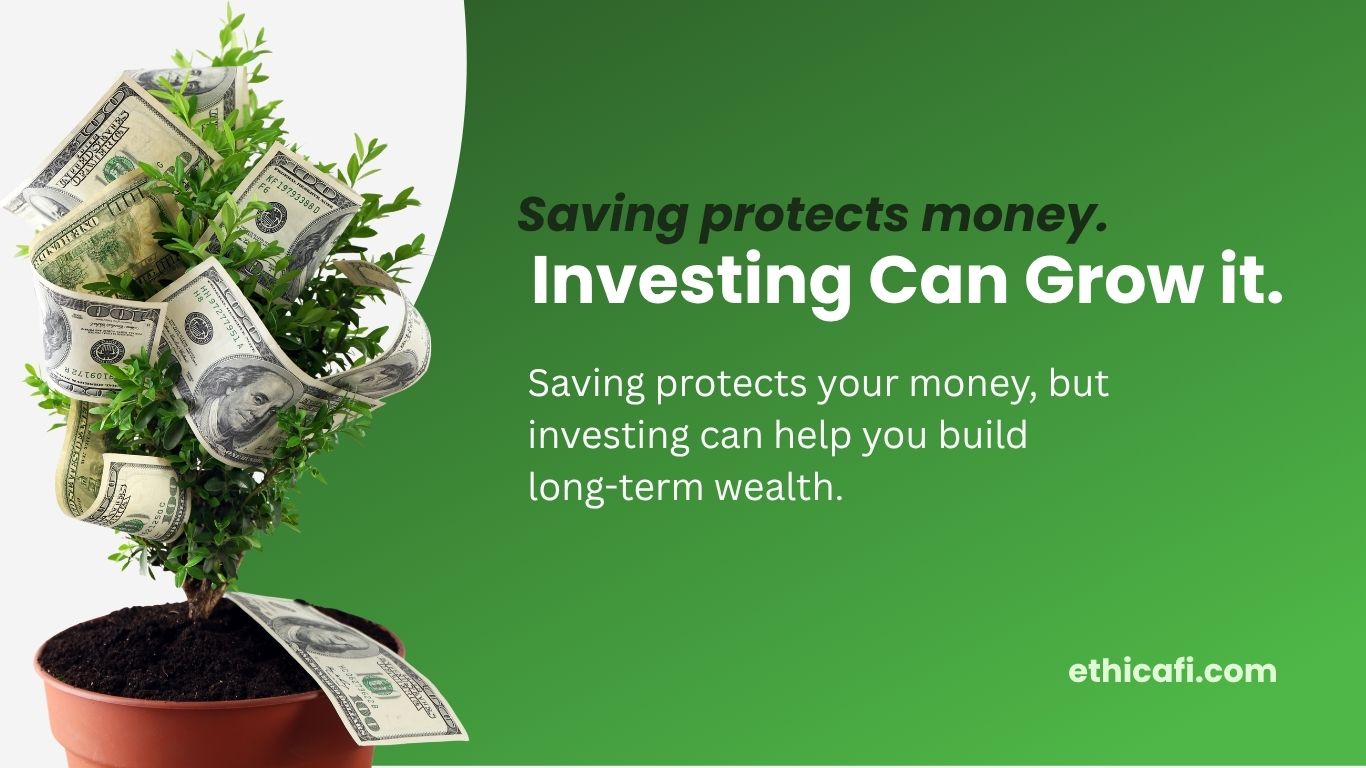
Saving money and investing money are often discussed as if they were competing choices. In reality, they usually serve different purposes. Saving can keep money accessible and stable for needs that are close at hand, while investing is generally considered for money that may not be needed for a longer period and can tolerate fluctuations in value.
Keeping every dollar in a savings account may feel reassuring, especially when uncertainty is high. But reassurance alone does not answer an important long-term question: will that money still have enough purchasing power to support your future goals? A thoughtful plan starts by understanding what cash is for, what investing involves, and how your financial decisions can fit with your values.
When a savings account is useful
A savings account can be an important foundation. Money held in an accessible account may help you handle an unexpected repair, a medical expense, a period without income, or a planned purchase. It can also make sense for money you expect to use soon, because a short time horizon leaves less room to recover from a market decline.
Cash reserves can support financial stability in several ways:
- Emergencies — funds that help you respond without immediately borrowing.
- Near-term goals — money for an upcoming move, tuition payment, travel plan, or major purchase.
- Peace of mind — a reserve that reduces pressure to sell a longer-term investment at an inconvenient time.
The trade-off is that a savings account may not be designed to grow substantially over many years. Its value is often found in access and stability, not necessarily in keeping pace with every future increase in costs.
How inflation can shrink purchasing power
Inflation means that prices rise over time. If a basket of groceries, a rent payment, or a service costs more in the future, the same amount of money will buy less than it does today. A balance can remain unchanged on a statement while its practical spending power gradually declines.
For example, if prices rise by an average of 3% a year, money that does not grow at a similar pace will lose purchasing power over time. The exact effect depends on future inflation, the account's return, taxes, and other factors, so this is an illustration rather than a prediction.
| Purpose | What may matter most |
|---|---|
| Savings | Access, stability, and short-term readiness |
| Long-term investing | Potential growth, time, diversification, and willingness to accept loss |
This does not make investing automatically better. It explains why a long-term plan may need to consider more than the amount shown in an account today.
You do not need to be wealthy to begin
Investing is sometimes presented as something reserved for people with large incomes or specialist knowledge. That picture can discourage people unnecessarily. Depending on the account, provider, and investment, someone may be able to begin with a modest amount and add gradually rather than waiting until they have a large lump sum.
Starting small does not remove the need for care. Before committing money, consider your budget, debts, emergency savings, time horizon, and ability to cope with a decline. A small beginning can be useful for learning, but it should never be treated as proof that a particular investment will succeed.
Investing is not the same as gambling
Both investing and gambling involve uncertainty, but they are not the same activity. Gambling generally depends on a game of chance in which participants risk money for a possible payout. Investing involves acquiring an asset, ownership interest, or contractual claim whose value and potential return depend on an underlying business, project, property, or other economic activity.
That distinction does not make investing safe. An investment can be poorly structured, overpriced, highly speculative, or based on incomplete information. A person who buys something solely because of excitement, social pressure, or a promise of quick money may be taking a gamble regardless of the label attached to it.
Be especially cautious when an opportunity emphasizes urgency, guaranteed profits, secrecy, or rewards for recruiting others. Those features do not establish that an investment is sound, lawful, or halal.
Understand the risk before considering the return
Every investment has risks, and the possibility of a higher return is not a free benefit. The value may fall, income may be lower than expected, the investment may be difficult to sell, or the entire principal may be at risk. Some products also carry credit, currency, interest-rate, business, regulatory, or concentration risks.
Risk is personal as well as mathematical. Two people may look at the same investment and reach different conclusions because their time horizons, obligations, income stability, and emotional capacity for loss are different. An investment that seems reasonable for a long-term goal may be inappropriate for money needed next month.
Read the terms in plain language
Before investing, identify what you are actually buying and how money is expected to move. Useful questions include:
| Term or feature | Question to ask |
|---|---|
| Principal | What amount could be lost, and under what circumstances? |
| Return | Where is the expected income or growth supposed to come from? |
| Fees | What charges reduce the amount I receive? |
| Liquidity | How and when can I access the money? |
| Term | How long might my money be committed? |
| Conditions | What assumptions, restrictions, or events could change the outcome? |
If the explanation is unclear, ask for clarification and take time to review the offering documents. Understanding the structure does not eliminate risk, but not understanding it makes informed decision-making much harder.
Questions Muslim investors may ask about halal investing
For Muslim investors, financial analysis may be only one part of the decision. You may also ask whether the investment is halal, what activities it supports, how the transaction is structured, and whether the way returns are generated is consistent with your understanding of Shariah principles.
That review may require looking beyond a headline return. Consider questions such as:
- Underlying activity — What business, asset, project, or service is being financed?
- Source of returns — Are returns connected to ownership, trade, leasing, profit-sharing, fees, or another arrangement?
- Contract structure — What rights, obligations, risks, guarantees, and conditions are set out in the agreement?
- Screening and oversight — Who reviewed the investment, what standards were used, and how are changes monitored?
The details matter. Two opportunities can use similar language about ethical or faith-aligned investing while having materially different assets, contracts, fees, and risk-sharing arrangements. A halal label or marketing description should not replace reading the specific documents.
Practical steps for a careful beginning
There is no obligation to invest simply because other people are doing so. If you decide to explore it, move at a pace that allows you to understand the decision rather than react to pressure.
- Build an emergency fund that reflects your circumstances before directing money toward a long-term investment.
- Learn the basics of diversification, time horizon, volatility, fees, liquidity, and the difference between potential return and guaranteed income.
- Start only with money that can remain invested for the relevant period and that you could afford to lose without jeopardizing essential needs.
- Review the investment structure, offering terms, costs, risks, restrictions, and the way returns are generated.
- Ask questions and consult appropriately qualified financial and Shariah professionals where the decision is complex or your circumstances require specialist guidance.
A balanced way forward
Keeping money in savings can be sensible when access, stability, and short-term obligations come first. For longer-term goals, however, leaving all of your money in cash may expose you to the gradual loss of purchasing power. Investing may offer a way to participate in long-term growth, but it also introduces uncertainty and is not suitable for everyone.
The most useful decision is often not an all-or-nothing choice. Separate money by purpose, understand the trade-offs, and make choices that reflect both your financial reality and your values. Thoughtful progress matters more than chasing a promised outcome.